


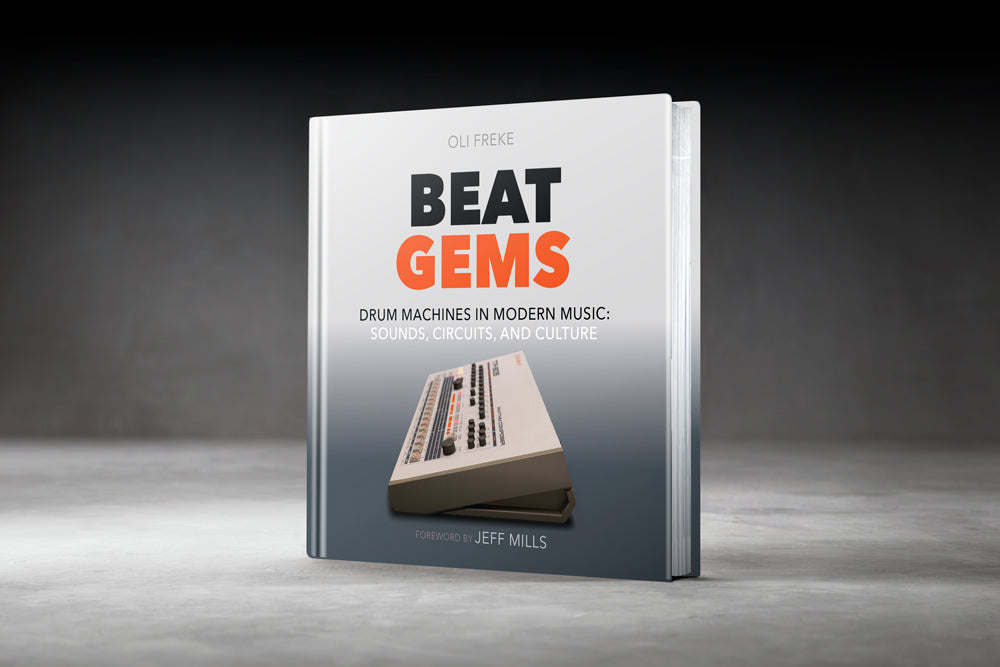
What better accompaniment to reading our new book, BEAT GEMS, than a curated playlist of tracks featured in it? From early 1960s experiments to contemporary trap, BEAT GEMS author Oli Freke has compiled a list of songs that show the drum machine's extraordinary role in shaping musical culture over more than six decades.
The playlist is organised in chronological order of song release, making for a fascinating listening experience as music genres and styles develop over time - from pop to krautrock to house, techno, hip-hop, and beyond. I also think that most of these tracks are absolutely brilliant, and they make for an extremely joyful listening experience, regardless of drum machine use!
The tracks have been selected for their notable use of drum machines. Some are among the first commercial recordings to feature a groundbreaking new machine; others show innovative ways to incorporate electronic rhythms into songwriting and production. In every case, they reveal how musicians responded creatively to the possibilities this emerging technology offered, a central theme in the story of drum machines told in BEAT GEMS.
Enjoy!
 BJOOKS
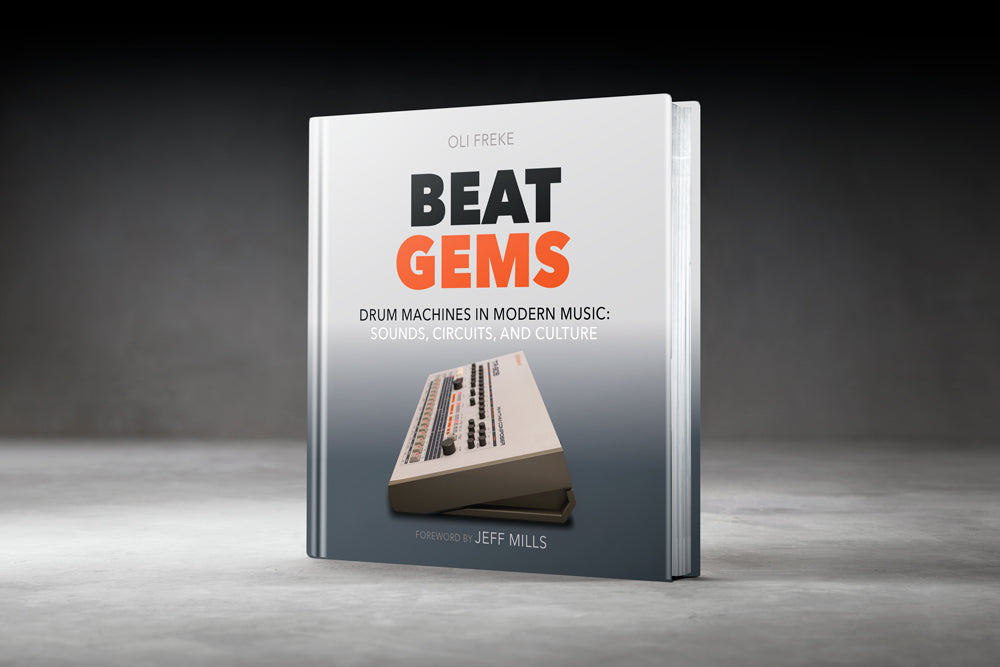
Song list with notes
The United States of America, Garden of Earthly Delights (1968). [Customized drums and effects]
Psychedelic experimentation, with homemade electronic percussion created by drummer Craig Woodson, piezo-triggered sounds from an acoustic drum kit. An example of how experimental bands were dabbling in electronic percussion at the time.
Dick Hyman, The Minotaur (8 min version) (1969). [Maestro Rhythm Master]
An eight-minute Moog-fuelled electronic odyssey, with wild, swooping synthesizer solos and octave-spanning glissandos in the psychedelic vein. A drum machine provides the unusual, loping rhythm, reportedly combining waltz and bossa nova patterns. An early and influential combination of electronic percussion and synth improvisation.
Robin Gibb, Saved By The Bell (1969). [Ace Tone FR-1]
One of the earliest hits to feature a drum machine (the Ace Tone FR-1), reaching No. 2 in the UK charts in 1969. Robin Gibb was on sabbatical from the Bee Gees at the time.
Little Sister, Somebody's Watching You (1970). [Maestro Rhythm King]
Sly Stone's record label, Stone Flower, released tracks like this one by Little Sister, featuring his younger sister, Vet Stone.
Can, Peking-O (1971). [Unknown drum machine]
The drum machine appears around 2:35. A theme of BEAT GEMS is represented here – the 'misuse' of the drum machine, rather than limiting it to 'simple rhythm accompaniment'. For example, setting the tempo to maximum (around 5:00) and stopping and starting it for musical effect.
Jimi Hendrix, Sweet Angel (Angel) (1971). [Prob. an Ace Tone FR-1]
This rare demo from the 'South Saturn Delta' sessions sees Hendrix use a drum machine for a temporary rhythm track. These early preset machines often served as a more interesting metronome for recording sessions or demos, but they usually didn't make it to the final release.
Moody Blues, Procession (1971). [Home-made drum kit]
An early electronic drum system using rubber pads. Drummer Graeme Edge and Sussex University electronics professor Brian Groves custom-built this set. Featuring touch-sensitive rubber pads that triggered electronically generated sounds, the transistor-based system included five snares, ten tom-toms, a pedal-operated octave of bass drums and multiple sequencers. An ambitious, if somewhat temperamental, precursor to the modern electronic drum kit.
JJ Cale, Crazy Mama (1972). [Ace Tone Rhythm Ace (unit unknown)]
An early and tasteful use of a drum machine in rock music. Cale used an Ace Tone Rhythm Ace for the rhythm on 'Crazy Mama' and 'Call Me the Breeze', largely out of financial necessity. Leon Russell was involved with JJ Cale's early career and, when he later worked with Roger Linn, brought his interest in drum machines with him... possibly inspiring Mr. Linn and his subsequent revolutions in drum machine development!
Kingdom Come, Spirit of Joy (1972). [Bentley Rhythm Ace]
An early rock band to dispense with a drummer and use a rhythm machine instead, both in the studio and on tour.
Sly & Family Stone, Family Affair (1972). [Maestro Rhythm King MRK-2]
Sly called his Maestro Rhythm King his 'Funk Box', and this may be one of the earliest global hits to be built around a drum machine. Sly exploits the rigidity of the drum machine, weaving his fluid bass playing around it – man / machine!
Timmy Thomas, Why Can't We Live Together (1972). [Lowrey Organ with AR-4 Automatic Rhythm]
Thomas used the built-in rhythm accompaniment on his Lowrey Organ for this influential, leftfield soul classic.
ELP, Toccata (Brain Salad Surgery) (1973). [Home-made drum kit]
Carl Palmer claims this is the first electronically generated drum solo on a commercial recording, using pick-ups on his acoustic drums to trigger synths; the wild electronic tones around 5:00 have been mistaken for Emerson's synths, but they're drum-triggered!
Bob Marley and the Wailers, So Jah S'eh (1974). [Prob. Maestro Rhythm King]
This is arguably one of the earliest reggae tracks to use a drum machine — along with other recordings at this time, notably No Woman No Cry.
Bob Marley and the Wailers, No Woman No Cry (1974). [Prob. Maestro Rhythm King]
How did I never notice this was a drum machine before?
Brian Eno, The Great Pretender (1974). [Bentley Rhythm Ace (prob.)]
Prominent preset machine – and nice prepared piano too!
Cluster, Caramel (1974). [Elka Drummer One]
Cluster were a prominent krautrock group of the mid-70s – 'the most important rock band in the world', according to Brian Eno at the time. They used an Elka Drummer One, heavily processed with effects, to create more textured rhythms.
George MacRae, Rock Your Baby (1974). [Roland TR-77]
A soul classic that uses a Roland TR-77 – the first product the newly founded Roland released.
Harmonia, Dino (1974). [Elka Drummer One]
The krautrock 'supergroup' – Cluster (Hans-Joachim Roedelius and Dieter Moebius) with Michael Rother of Neu! – makes great use of a drum machine.
Kraftwerk, Autobahn (1974). [Farfisa Rhythm 10]
Wolfgang Flür rigged his Farfisa Rhythm 10 so his famous homemade electronic drum pad system could trigger the individual drum sounds.
Parliament, The Goose (1974). [Unidentified drum machine]
Another great funk group to make prominent use of a drum machine, overlaid with acoustic drums and percussion.
Jean-Michel Jarre, Oxygene IV (1976). [Keio Mini Pops 7]
The Keio MP-7 brings its unique percussion sounds - quijada anyone? - to the emerging genre of popular electronic music, lending Jarre's classic its distinctive rhythmic sound world.
Carly Simon, Nobody Does It Better (1977). [Pollard SynDrum]
Arguably the first recording to feature the Pollard Syndrum (tom fills) played by legendary drummer Jeff Porcaro.
Iggy Pop, Night Clubbing (1977). [Roland CR-78]
Co-written by David Bowie, the song features a Roland CR-78 processed through effects to give it a darker character. Its mechanical pulse, combined with the sparse bass and guitar, is fundamental to the track's distinctive, minimalist atmosphere. Bowie wanted to re-record it with real drums — but Iggy disagreed...
The Congos, Congoman (1977). [Roland CR-78]
Produced by Lee 'Scratch' Perry, this is another great reggae track to use a drum machine (the Roland CR-78). The better-known classic 'Fisherman' is on this album.
Ultravox, Hiroshima Mon Amour (1977). [Roland TR-77]
The Roland TR-77 was Roland's first product, drawing on the experience founder Ikutaro Kakehashi gained at Ace Tone over the previous decade. Ultravox's Warren Cann manipulated the unit's controls in real time to overcome the limitations of its preset rhythms.
Blondie, Heart of Glass (1978). [Roland CR-78]
The opening famously used the CR-78 with the beguine and mambo buttons pressed down to combine the rhythms, and Jimmy Destri's Roland SH-5 synced to it for the bassline.
Echo and the Bunnymen, Pictures on the Wall (1979). [Korg Minipops]
The original three-piece line-up used a drum machine they nicknamed 'Echo', which also gave the band its name. Its mechanical pulse provides the rhythmic foundation for this atmospheric debut single, recorded before Pete de Freitas joined as drummer. The machine was reportedly painted fluorescent green, but the band later had it stolen from its Liverpool rehearsal space.
Roxy Music, Dance Away (1979). [Roland CR-78*]
Bryan Ferry originally developed this song around a rhythm box, having unsuccessfully attempted to record it for two earlier solo albums. The simple, mechanical pulse provided the foundation for the eventual Roxy Music hit, with the other instrumentation added around it.*The precise model attribution remains to be confirmed: Dan LeRoy’s well-researched book says CR-78, but this blog says TR-66. I’m going with the researched book, not the unattributed blog claim!
Sparks, No. 1 in Heaven (1979). [Drum synth unknown]
Sparks illustrate the popularity of the disco 'pew-pew' tom sound in the introduction to this great track.
Blondie, Atomic (1980). [Roland CR-78]
Prominent use of the CR-78, especially in the middle eight. Note the 'metal beat' sound - arguably the first synthetic drum sound on a drum machine – i.e. one that wasn't trying to imitate an acoustic drum in the real world.
Genesis, Duchess (1980). [Roland CR-78]
The first prominent use of a drum machine on a Genesis recording, combined with Phil Collins drumming on an acoustic kit.
Paul McCartney, Secret Friend (1980). [Unknown]
McCartney in experimental mode: an extended electronic excursion from the McCartney II sessions, built up by McCartney alone using synthesizers, drum machines, effects and tape.
Peter Gabriel, Biko (1980). [PAiA Programmable Drum Set]
Probably the first widely heard song to use a programmable drum machine - the PAiA Programmable Drum Set. A basic DIY machine, it nevertheless provides the distinctive high bongo sound throughout the song.
Steely Dan, Hey Nineteen (1980). [Wendel - COMPAL-80 mini-computer]
An early example of sampled drum sounds, generated by a COMPAL-80 computer running custom software. Dubbed the Wendel, the system was built by Roger Nichols, the legendary recording engineer and hardware designer. Steely Dan were notorious perfectionists, and the Wendel let them place drums with ultimate precision; they took two years to make this album.
Steve Winwood, Spanish Dancer (1980). [Linn LM-1]
An early song to feature the Linn LM-1, the first commercial drum machine to use samples instead of analog sounds. Steve Winwood combines the LM-1's sounds with acoustic drums and sequenced synthesizer rhythms to create this gently disco-inflected groove.
Trio, Da Da Da (1980). [Casio VL-1]
A track that shows that cheap kit (a Casio VL-1), a good tune, and a sense of humor can take you a long way!
Ultravox, Astrodyne (1980). [Star Instruments Synare & CR-78]
Opens with the CR-78's distinctive Metal Beat sound, though the machine is subsequently overlaid with acoustic drums. Illustrates how synthpop/new wave bands embraced the newly programmable options offered by the CR-78 — the first widely available, good-sounding, programmable drum machine. See also John Foxx's Metamatic album.
Davy DMX, One For The Treble (1981). [Oberheim DMX]
An early hip-hop/electro showcase for the Oberheim DMX, the drum machine from which Davy Reeves took his adopted name.
Depeche Mode, Dreaming of Me (1981). [Korg KR-55]
Check out the Korg KR-55's beautiful (analog) snare drum on this synthpop classic. (The kick is an ARP 2600 synthesizer, as producer Daniel Miller did not rate the machine's own bass drum.)
Elton John, Nobody Wins (1981). [Linn LM-1]
Roger Linn has been quoted as saying that this is how his new machine should be used — to sound like a real drummer is playing. No surprise, then, that legendary drummer Jeff Porcaro programmed the Linn LM-1.
George Benson, Turn Your Love Around (1981). [Linn LM-1]Another early Linn LM-1 hit. Jeff Porcaro programmed it (again!). They tried replacing the LM-1 temp track, but it simply wasn't as good. This represents the start of the era when drum machines were considered good enough to carry a whole song without a drummer and acoustic drum kit.
Hall & Oates, I Can't Go For That (No Can Do) (1981). [Roland CR-78]
Built around the Roland CR-78's Rock 1 preset, which provided the starting point for Daryl Hall's bassline and the song's distinctive groove. They tried replacing it with acoustic drums, but it sounded too 'heavy'. Michael Jackson cited this song as an inspiration for the Billie Jean groove.
Kraftwerk, Pocket Calculator (1981). [Mattel Bee Gees]
Not strictly a drum sound, this one: the Mattel Bee Gees toy keyboard provided the lead line, with Florian Schneider performing on it live and even inviting audience participation. However, the machine's three basic rhythms weren't used at all.
Phil Collins, In The Air Tonight (1981). [Roland CR-78]
A classic song that brought the CR-78 to a wide audience — before its delicate ticking is comprehensively demolished by a completely unnecessary drum fill (British irony may occur). Thanks, Phil!
Soft Cell, Tainted Love (1981). [Roland CR-68]
The CR-68 provides the basic groove. Engineer Paul Hardiman separated the kick and snare for independent processing, while an EHX Crash Pad and Star Instruments Synare provide the triplet zaps and other effects.
Spandau Ballet, Chant No. 1 (1981). [Simmons SDSV]
One of the earliest hits to feature the distinctive hexagonal drum pads of the Simmons SDSV — and its equally distinctive electro tom sound.
The Human League, Don't You Want Me (1981). [Linn LM-1]
A huge synthpop classic that used the LM-1, but note the lack of crash and ride cymbals; digital memory was too expensive for the machine to include these long sounds.
Afrika Bambaataa, Planet Rock (1982). [Roland TR-808]
Electro was the first genre centered around the Roland TR-808, and this track kicked it all off. It blended Kraftwerk-inspired beats and riffs with vocoded vocals and orchestral stabs that set the framework for the style.
Marvin Gaye, Sexual Healing (1982). [Roland TR-808]
Recorded in Belgium while Marvin Gaye was on sabbatical, this is a definitive TR-808 song that sets the tone for the 808's soulful side. Gaye's credited in the sleeve notes with playing the conga, bells, and cymbals — the drum sounds on the machine.
Patrice Rushen, Forget Me Nots (1982). [Human hand-claps]
The hand-clap unit was a common stand-alone piece of hardware in the late 70s and early 80s, reflecting its popularity in disco tracks. Interestingly, this track processes human handclaps to sound electronic. Will Smith sampled it for 'The Men in Black' in 1997.
Prince, 1999 (1982). [Linn LM-1]
Prince is synonymous with the Linn LM-1, at least in this 1980s phase, and he used it across multiple tracks. Roger Linn once referred to him as his 'marketing department'; such was Prince's public admiration for the machine.
Sisters of Mercy, Adrenochrome (1982). [BOSS DR-55]
The Sisters of Mercy are well known for using a drum machine instead of a human drummer, which they always refer to as ‘Doktor Avalanche’. Their earliest work used a BOSS DR-55, but they subsequently used the Oberheim DMX, Roland TR-808, and more.
Big Black, I’m a Mess (1983). [Roland TR-606]
Legendary producer Steve Albini loved his TR-606, and his band Big Black used it live and on recordings like this one. From a gig at CBGB, New York, in 1986, this memorable exchange: Steve: ‘I’m sorry to report that our drum machine just blew up.’ Audience heckler: ‘Get a real drummer.’ Steve: ‘Drummers get drunk.’
Billy Idol, Eyes Without a Face (1983). [LinnDrum]
Keith Forsey programmed the LinnDrum and layered it with live drums. The LinnDrum became a central sound on Rebel Yell, making this a good example of drum machines crossing over into mainstream rock.
Genesis, Mama (1983). [Linn LM-1]
Programmed by Mike Rutherford, this is a great example of drum machines crossing over into mainstream rock and being used creatively.
Herbie Hancock, Rockit (1983). [Oberheim DMX]
A classic electro track by jazz-funk maestro Herbie Hancock, using an Oberheim DMX.
New Order, Blue Monday (1983). [Oberheim DMX]
One of the most famous drum machine patterns of all time — that kick drum roll was actually inspired by the chorus in Donna Summer's 'Our Love'.
S.O.S. Band, Just Be Good To Me (1983). [Roland TR-808]
The 808 comes to R&B, courtesy of producers Jam & Lewis.
The Eurythmics, Sweet Dreams (1983). [Movement Percussion Computer]
The esoteric Movement Percussion Computer wouldn't put the 'boom' (low tom) on beat two where Dave Stewart wanted it. So it's on beat one, where it sounds great. The machine contributes to the art through accident!
ZZ Top, Sharp Dressed Man (1983). [Prob. Oberheim DMX]
Other styles beyond dance and pop began to rely on the drum machine; here's an archetypal rock band: ZZ Top.
Don Henley, The Boys of Summer (1984). [LinnDrum]
The LinnDrum establishes itself in rock music, and this is one of its defining songs of the decade.
Egyptian Lover, Egypt, Egypt (1984). [TR-808]
The 808's cowbell was a cornerstone sound of 80s electro, later to become something of a comical cliché ('needs more cowbell').
Run-DMC, Sucker MCs (1984). [Oberheim DMX]
Classic use of the Oberheim DMX in 80s hip-hop, where it was highly prized. 'It's Like That' was the B-side — a hip-hop classic.
Skinny Puppy, Smothered Hope (1984). [Roland TR-909]
One of the earliest Roland TR-909 records, even before it became 'the techno drum machine'. Like techno producers, Skinny Puppy found distorting and processing the kick rewarding.
Strike, U Sure Do (1984). [Roland CR-78]
A techno-house track extolling the virtues of the drum machine and the CR-78.
T La Rock, It’s Yours (1984). [Roland TR-808]
Produced by Rick Rubin, this is one of the earliest hip-hop tracks to exploit the 808’s booming bass drum. The 808's extended decay control and deep sine bass formed the basis of many genres, from hip-hop to trap and Miami bass to funk carioca.
A-Ha, Take On Me (1985). [LinnDrum]
A-ha's Paul Waaktaar-Savoy programmed the LinnDrum for this global hit. An earlier version of the song was written on a Fairlight, but the band didn't like it, so they made this definitive version and a defining 80s pop record.
Tom Petty and the Heartbreakers, Don't Come Around Here No More (1985). [Oberheim DMX]
Dave Stewart (The Eurythmics) wrote this song around a distinctive Oberheim DMX pattern, bass synth, and electric sitar. Originally intended for Stevie Nicks, it eventually landed with Tom Petty.
Wayne Smith, Under Mi Sleng Teng (1985). [Casio MT-40]
This breakthrough riddim was built around the drums and auto-accompaniment pattern of the Casio MT-40 home keyboard, and is credited with starting the digital reggae era. Okuda Hiroko programmed the preset in her first year at Casio. Cultural exchange at its best!
Mantronix, Bassline (1986). [Roland TR-909]
Predating DJ Pierre's breakthrough 'Acid Tracks', this track makes effective use of the TR-909's shuffle function alongside the unmistakable squelch of the TB-303.
Adonis, No Way Back (1987). [Roland TR-808]
Chicago House pioneer Adonis gives the 808 a solid workout, reflecting its status at the heart of the underground club sound.
Steve 'Silk' Hurley, Jack Your Body (1987). [Roland TR-808]
Landmark house track built around the TR-808. An underground hit in Chicago, it failed to make the US Billboard Hot 100. However, it reached No. 1 in the UK, bringing Chicago house to mainstream attention and helping build towards the acid-house, rave and dance revolution to follow.
Rick Astley, Never Gonna Give You Up (1987). [Linn 9000]
Produced by Stock, Aitken and Waterman on their beloved Linn 9000. They used it for years after they could have moved to their computer-based studio, despite the Linn 9000 being notoriously buggy and prone to crashes (problems that contributed to Linn Instruments' collapse in 1986).
HEALTH, Godflesh, SICKO feat. Godflesh (1988). [Alesis HR-16]
Godflesh are well known for using the Alesis HR-16 for drums. Unusual for a heavy metal/industrial band!
Public Enemy, Don't Believe the Hype (1988). [E-mu SP-1200]
The sampling drum machines ushered in a new phase of hip-hop. The gritty-sounding E-mu SP-12 and SP-1200 were two of the key machines used by many prominent artists, giving this phase of hip-hop its distinctive sound.
Technotronic, Pump Up the Jam (1989). [Roland TR-909]
The underground techno and house scene discovered the TR-909— and it wasn’t long before the mainstream exploited it in pop-dance crossover tracks.
Carter USM, A Perfect Day to Drop the Bomb (1990). [Yamaha RX15]
A song on the band's 101 Damnations album that features a Yamaha RX15 databurst at the start and relies on the machine for the drum track. Carter USM were one of the few 90s indie bands to exclusively use drum machines, not drummers.
Madonna, Vogue (1990). [Roland TR-909]
A fine pop song that makes great use of the 909, which was commonly heard in crossover/pop-dance hits of the era.
Aphex Twin, Xtal (1992). [Roland TR-808 - probably/possibly?]
From a landmark electronic music album, Xtal is typical of Ambient Works Vol. 1 - atmospheric, hypnotic, and gently melodic. Although Aphex Twin has spoken of using modified TR-808 sounds, Mike Paradinas (μ-Ziq) has also been quoted as identifying the Roland R-8 as a drum source on Selected Ambient Works 85–92, though maybe not on Xtal.
Rotterdam Termination Source, Poing (1993). [Roland TR-909]
The TR-909's harder sound matched the music coming out of Europe: EBM and New Beat from Belgium, techno from Detroit, and hardcore and gabber from the Netherlands. This track is as raw a 909 track as you could hope for, if not completely ridiculous. 😄
Jeff Mills, The Bells (1996). [Roland TR-909]
Jeff Mills is rightly known as 'The Wizard', and his classic 'The Bells' illustrates the Roland TR-909's central role in techno.
808 State, 606 (2002). [Roland TR-606]
A band named after a Roland drum machine names a song after another Roland drum machine. (As well as the tracks 'Pacific - 707', 'Pacific 202'...)
J Dilla, Lightworks (2006). [Akai MPC3000]
J Dilla was a leading proponent of the art of the Akai MPC, a self-contained sampling drum/production workstation. The term 'dilla-time' describes his loping, wonky approach to rhythm construction.
DJ Shadow, The Number Song (2006). [Akai MPC60]
DJ Shadow pushed the collage approach to sampling to the limits on Endtroducing, his album made solely with an MPC60, Technics SL-1200 and Alesis DAT machine - and a collection of vinyl!
Aphex Twin, MARCHROMT30A edit 2b 96 (2014). [Yamaha RX11]
RDJ said on SoundCloud, 'Something about this [Yamaha] RX11 - it's shit, but I just love using it.'
Future, Stick Talk (2015). [Probably DAW]
By the 2010s, trap had turned the 808’s booming kick drum into the bassline itself, molded into elastic perfection. This is an example of the 808's influence in a style where the bassline is often referred to as ‘the 808’, rather than as a sample or the machine itself.
 BJOOKS
Join the club...
Become a Member to unlock more content – including all seven ebooks (2000+ pages!). Discover, learn, and get inspired – wherever you are in your synth journey.
Choose your membership now!


Comments